
7 Best Creem Alternatives for 2026 (Fees, MoR & Maturity Compared)

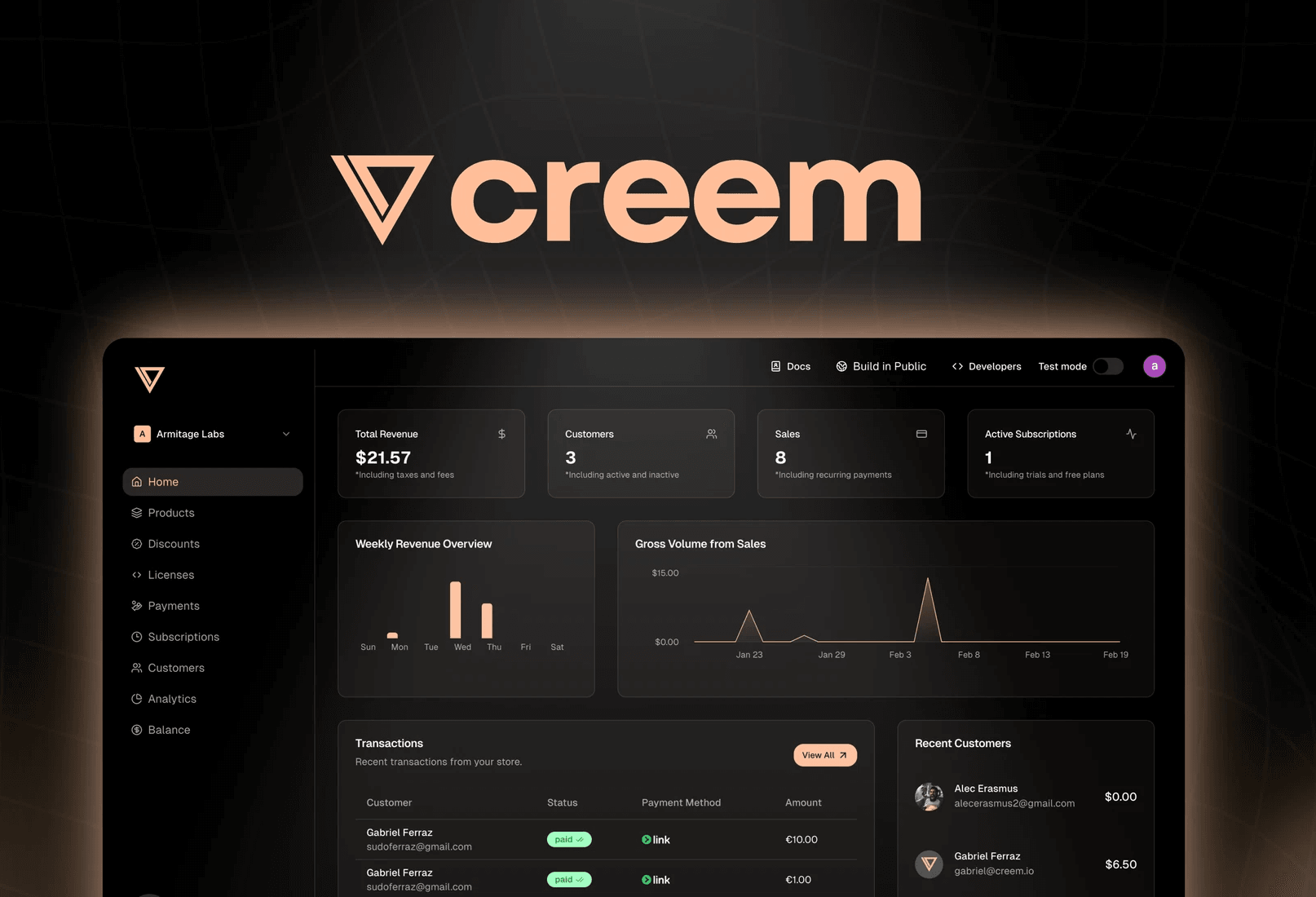
An honest review of Creem plus the 7 best Creem alternatives for 2026: Comecero, Lemon Squeezy, Paddle, Polar, Dodo, FastSpring, and Gumroad, compared on fees, merchant-of-record coverage, billing flexibility, platform maturity, and how well they scale.
7 Best Creem Alternatives for 2026 (Fees, MoR & Maturity Compared)
Creem is one of the most talked-about names in the new wave of merchants of record, a lightweight platform aimed squarely at indie hackers and AI startups who want payments, tax, and compliance handled without enterprise onboarding. For a solo founder launching a product this month, its pitch is genuinely appealing: sign up fast, start selling globally, let the platform carry the tax burden.
But "new wave" cuts both ways. The same youth that makes Creem fast and friendly also means a short track record, a smaller feature surface, and open questions about how it handles scale, B2B complexity, and revenue you can't afford to disrupt. Whether you're evaluating Creem for the first time or already on it and feeling the edges, this guide covers what Creem actually offers, what it costs, and the seven strongest alternatives for 2026. Jump to the comparison table if you want the short version.
What Is Creem? (A Quick, Honest Review)
Creem is a merchant of record (MoR) for digital products, SaaS, and AI startups. As the MoR, it becomes the legal seller on each transaction. It collects and remits sales tax and VAT globally and handles compliance and chargebacks, so founders don't have to register for taxes across jurisdictions or manage that liability themselves.
Its positioning is deliberately lightweight: fast signup, simple checkout, subscriptions and one-time purchases, license keys, and startup-friendly pricing, with a community and brand that speak directly to indie hackers and AI builders. In a market where the incumbent MoRs can feel heavy or opinionated, that focus is the appeal.
The honest trade-offs, as with any young platform:
- Track record. Creem is one of the newest names in the category. Payments is a trust business: uptime, payout reliability, risk handling, and dispute management only prove themselves over years.
- Feature depth. Lightweight is great until you need quoting, B2B invoicing, complex subscription logic, high-ticket acceptance, or serious usage metering.
- Risk and account stability. Young MoRs are still tuning their risk models, which can mean more conservative holds, reviews, or category restrictions as they grow.
None of that makes Creem a bad choice. For an early-stage indie or AI product it's a credible one. It makes Creem a stage-specific choice, which is exactly why the alternatives matter.
Creem Pricing and Fees (2026)
Creem prices as a blended per-transaction rate in the same neighborhood as other indie-focused MoRs, historically advertised around 3.9% + 40¢ per transaction, with no monthly platform fee. Additional fees can apply depending on payment method, currency, and payout configuration, and rates for the newest platforms change often, so verify current numbers on their site before deciding.
The comparison to run is the same one we recommend for every MoR: not headline rate vs. headline rate, but your effective all-in cost on your real order profile, including what weak dunning, failed-payment recovery, and checkout conversion leave on the table. On those dimensions, platform maturity tends to matter more than a half-point of fees.
Why Look for a Creem Alternative?
The consistent reasons teams evaluate alternatives:
- You need a longer track record. If your product is past hobby stage, your MoR is your entire revenue pipeline. Many teams simply want more operating history behind the platform that holds their money.
- You're scaling into B2B or high-ticket. Invoicing, quotes, purchase orders, net terms, and acceptance on large transactions are where lightweight platforms thin out fast.
- Your billing is getting complex. Seat-based plans, usage metering, credits, hybrid models, and mid-cycle changes need real billing infrastructure, not just a checkout.
- Revenue recovery matters now. At early volume, a failed payment is an annoyance; at scale, dunning quality, smart retries, and checkout conversion are worth more than any fee difference.
- Support depth. When a payout or account review is blocking revenue, you want a team with the experience, and the staffing, to resolve it quickly.
The 7 Best Creem Alternatives for 2026
1. Comecero: best for teams that want modern billing with real depth
Comecero is a merchant of record and billing platform built for SaaS, AI, and digital sellers. It covers the same ground as Creem (global tax and VAT, chargebacks, PCI compliance, fast setup) but adds the billing depth lightweight platforms lack: usage-based and hybrid billing, high-ticket acceptance, B2B workflows, and a deliberate focus on minimizing revenue leakage through conversion-tuned checkout, dunning, and smart retries.
- Best for: Indie and AI teams that like Creem's modern approach but want a platform they won't outgrow, plus anyone selling B2B or high-ticket.
- Strengths: Revenue-recovery tooling, usage-based billing, strong acceptance on large orders, flexible rates, hands-on support.
- Worth knowing: Newer than the legacy MoRs (though more established than Creem), which translates into willingness to tailor and negotiate.
2. Lemon Squeezy: best-known indie MoR
Lemon Squeezy is the platform that popularized MoR-for-indie-hackers, and it remains the most established option in that segment, now owned by Stripe.
- Best for: Solo founders and small teams selling digital products and early-stage SaaS who want the most proven indie-focused option.
- Strengths: Mature indie feature set, large community, Stripe's infrastructure behind it.
- Trade-off: Same scaling ceiling as any creator-first tool, and its 5% + 50¢ pricing is higher than Creem's. (See our full Lemon Squeezy alternatives comparison.)
3. Paddle: best established MoR for scaling SaaS
Paddle is the reference point for modern MoRs: payments, tax, compliance, and subscription billing in one developer-friendly, well-documented stack, with years of operating history and thousands of SaaS customers.
- Best for: SaaS teams past the earliest stage that want an established, API-first MoR.
- Strengths: Mature platform, strong subscription tooling, proven at scale.
- Trade-off: More opinionated and heavier to onboard than Creem; blended pricing can feel high at volume. (See our Paddle alternatives comparison.)
4. Polar: best open-source alternative in the same generation
Polar is Creem's closest peer: a developer-first, open-source MoR for digital products and SaaS with competitive pricing and a clean API.
- Best for: Developers who want a modern lightweight MoR and value open-source transparency.
- Strengths: Open codebase, developer experience, low friction.
- Trade-off: Same category caveat as Creem: young platform, thinner B2B/high-ticket tooling.
5. Dodo Payments: best newer MoR for usage billing
Dodo is another recent entrant, differentiating on native usage-based billing alongside subscriptions, with transparent pricing and quick implementation.
- Best for: Early-stage AI products where metered billing is central.
- Strengths: Usage billing, pricing clarity, speed to launch.
- Trade-off: Short track record, like the rest of the new wave.
6. FastSpring: best mature platform for software sellers
FastSpring has been a merchant of record for software and digital goods for two decades, the opposite end of the maturity spectrum from Creem.
- Best for: Software sellers who prioritize operating history and global tax coverage over modern billing features.
- Strengths: Long track record, broad tax handling, established processes.
- Trade-off: Traditional platform and checkout; thin on usage-based billing. (See our FastSpring alternatives comparison.)
7. Gumroad: simplest option for one-off digital products
Gumroad is the long-standing creator MoR: storefront, checkout, and compliance for digital downloads and memberships with famously minimal setup.
- Best for: Creators selling one-off products who want the absolute simplest path.
- Strengths: Simplicity, built-in audience tools, years of history.
- Trade-off: Not built for SaaS billing, B2B, or high-ticket; per-sale fees are high.
Creem Alternatives Compared at a Glance
| Platform | True MoR? | Maturity | Usage billing | B2B / high-ticket | Best for |
|---|---|---|---|---|---|
| Creem | Yes | New | Partial | Limited | Indie / AI launch stage |
| Comecero | Yes | Growing | Supported | Strong | Scaling SaaS, AI & high-ticket |
| Lemon Squeezy | Yes | Established | Limited | Limited | Indie / small teams |
| Paddle | Yes | Established | Yes | Moderate | Scaling SaaS |
| Polar | Yes | New | Partial | Limited | Developers / open source |
| Dodo | Yes | New | Yes | Moderate | Usage-first startups |
| FastSpring | Yes | Legacy | Limited | Strong | Established software |
| Gumroad | Yes | Established | No | Limited | Creators / one-off |
Creem vs. Paddle vs. Lemon Squeezy: The Short Version
Since these are the three names most often shortlisted together:
- Creem is the lightest and cheapest to start with, and the youngest. Pick it for a brand-new indie or AI product where speed matters more than depth.
- Lemon Squeezy is the established indie choice: more proven, higher fees, same eventual ceiling.
- Paddle is the grown-up option: heavier onboarding and opinionated, but built for scale.
The pattern to notice: each step up in maturity trades away simplicity. The gap in the middle is modern developer experience and billing depth and revenue recovery, without enterprise onboarding. That is the gap Comecero is built to fill.
How to Choose
- Launching your first product this month: Creem, Polar, or Gumroad get you selling fastest. The risk is low because your volume is low. (See our full guide to choosing a merchant of record as a solo founder.)
- Revenue is becoming real: prioritize maturity and recovery, which points to Comecero or Paddle. Migrating later costs more than choosing right now, because stored payment methods don't transfer between MoRs.
- Usage-based pricing is core: Comecero or Dodo, which treat metering as a first-class feature. (See which merchant of record is best for usage-based billing.)
- You sell B2B or high-ticket: this rules out the lightweight tier entirely, leaving Comecero or FastSpring. (See what a high-ticket merchant account needs.)
Frequently Asked Questions
Everything else you might be wondering about.
The Bottom Line
Creem is a credible pick for the launch stage: modern, fast, and priced for indie hackers. The question isn't whether it's good. It's whether it's good for the stage you're heading into. Payments is the one part of your stack where a migration always hurts, so choose for the revenue you plan to have, not the revenue you have today.
If you want a merchant of record with modern developer experience and the billing depth, high-ticket acceptance, and revenue recovery to grow into, talk to the team at Comecero. We build merchant-of-record and billing infrastructure for SaaS, AI, and high-ticket sellers, without the enterprise setup.
Pricing, features, and MoR status change over time, so verify current details with each provider before deciding.